

How Carrying E-Bikes Can Change Your Travel Trailer’s Towing Stability
Posted by ProPride Hitch Team on 2nd Aug 2026
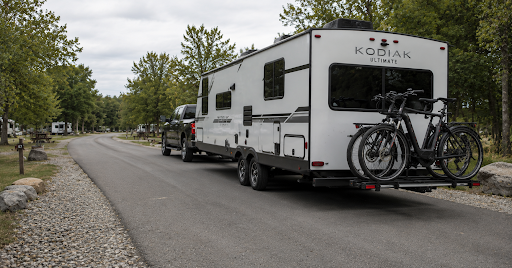
E-bikes are becoming a popular addition to RV trips. They make it easier to explore campgrounds, nearby trails, downtown areas, and destinations without moving your entire towing setup. However, e-bikes are considerably heavier than traditional bicycles, and adding them to your travel trailer can change how your entire rig is balanced.
Before installing an e-bike rack, it is important to understand that the location of the bikes matters just as much as their total weight.
Rear-Mounted E-Bikes Can Reduce Tongue Weight
Many RV owners place their bikes on a rack attached to the rear bumper or receiver of the travel trailer. This may be convenient, but weight added behind the trailer axles acts as leverage against the tongue.
Adding heavy cargo to the back of a travel trailer can reduce the amount of weight pressing down on the hitch. If tongue weight becomes too light, the trailer may become more susceptible to unstable side-to-side movement. The RV Industry Association specifically warns that loading too much weight behind a travel trailer’s axles can increase sway.
Two e-bikes and a heavy-duty rack can easily add several hundred pounds to the back of a trailer. That does not automatically mean the setup is unsafe, but it does mean the trailer should be weighed again after the rack and bikes are installed.
Do not assume the trailer’s original tongue-weight specification is still accurate.
Front-Mounted Bikes Increase Loaded Hitch Weight
Some owners carry e-bikes over the trailer’s A-frame or near the propane tanks. This keeps the bikes closer to the tow vehicle, but it can increase the trailer’s loaded hitch weight.
That added weight must be included when selecting and adjusting a weight distribution hitch. ProPride 3P® models are selected according to the trailer’s actual loaded hitch weight, with several available weight ratings for different towing setups.
The correct location depends on your trailer’s ratings, frame construction, existing cargo placement, and available carrying capacity.
Check Every Component’s Rating
Before installing a rack, confirm that:
- The trailer bumper, receiver, or A-frame is approved for the load.
- The bike rack is specifically rated for RV or travel-trailer use.
- The rack can support the combined weight of the bikes.
- The trailer remains within its GVWR and axle ratings.
- The tow vehicle remains within its payload and receiver ratings.
- The bikes cannot shift, bounce, or separate from the rack.
Cargo must be secured so it cannot fall, shift, leak, or escape from the vehicle during travel. That responsibility remains with the driver regardless of the type of rack being used.
Recheck Your Hitch Adjustment
After adding the bikes, load the trailer exactly as it will be used. Include water, propane, batteries, food, camping equipment, and passengers in the tow vehicle.
Measure the trailer’s actual loaded weight and tongue weight. You should also check the tow vehicle’s front and rear axle loads on a certified scale.
The ProPride 3P® uses weight distribution and Pivot Point Projection™ to create a stable towing connection, but no hitch replaces proper loading or manufacturer weight ratings. If the bikes change your loaded hitch weight, the weight distribution jacks may also require adjustment.
E-bikes can make an RV trip more enjoyable, but they should be treated as a meaningful part of the trailer’s cargo. Measure the completed setup instead of guessing. A few minutes spent verifying the weight can help protect your trailer, tow vehicle, bicycles, and everyone traveling with you.